 Back
Back

The Revenge of Don Mendo
THE CURTAIN RISES ON SOLIDARITY
This text tells how, in the 1983/84 season, the RCD Espanyol squad launched a groundbreaking charitable initiative by staging the play 'La Venganza de Don Mendo,' with the participation of all the players and coaching staff. The idea, promoted by captain Fernando Molinos and directed by Albert Pueyo, sought to strengthen team unity and raise funds for the Hospital Sant Joan de Déu in Barcelona.
The performance, held at the Martínez Soria theatre, was a resounding success, with Diego Maradona making a guest appearance. The project received significant media coverage and had a very positive impact on the group.

Act One: The Proposal
Nowadays, all professional sports clubs, and by extension, any large social entity, have marketing, institutional relations, communication and social departments, which channel and promote extra-sporting activities, from hospital visits, participation in charity and solidarity events, to social events in order to offer a different image, away from the merely sporting one. Therefore, the players participate, but they do not have to worry about their organization. However, it was not always like that.
Let's jump more than 40 years back in time. In 1983, Espanyol immediately dispensed with its coach, the Serbian Pavic. He was replaced by his assistant, a young Xabier Azkargorta, about to turn 30.
So young that even three players, Molinos, Giménez and Domínguez, are older than him.
Azkargorta, with a philosophical and integrating mood, sends a message to the staff to “pull together”, to “row as one”. Molinos, the captain, picks up the gauntlet and promotes a theatrical play - amateur and solidary - to make a united front. It quickly gets out of hand, since it will end up being performed in the Martínez Soria theater, full to the brim and with the presence of the president of the Generalitat, the honorable Jordi Pujol. They will also make a small live performance in the TVE Superstar program, in prime time on a Friday night, and presented by Lola Flores and Héctor de Mar.
The theatrical play had a double objective: the sporting aspect of making a group with a total involvement of the players - all 25 members of the squad participated - and the solidarity aspect. In this case, the proceeds would go to the children of the San Juan de Dios Hospital.
In this aspect, players and Club were innovative, ahead of their time and showing the solidary side that Espanyol promotes so much. The fans were also an example of involvement, and solidarity collections, charitable activities such as food collection during the pandemic or for the DANA, or blood donation with record donations, are common and highly praiseworthy. Without forgetting the Perico health fighters: Sabaté Pons, Robert Hernando, the little Ainhoa, the long-missed José Raúl. Solidarity and Espanyol hand in hand, now and always.
Second act: The play
Once the idea of staging a play had been consolidated, it was time to choose which one to perform. No trivial task, but it was quickly solved.
Molinos consulted with his father Antonio, former coach of clubs such as Numancia, Alavés and Burgos, among others, and it was clear. It has to be La Venganza de Don Mendo, a classic work that encompasses everything: it is funny, with a large number of characters and in a format that goes through almost all the strophic forms of Castilian poetry, giving more emphasis to the plot.
Its author, Pedro Muñoz Seca (20-02-1874, El Puerto de Santa Maria, Cádiz), is one of the fundamental names of the theater scene of the last century, with more than a hundred plays such as El teniente alcalde de Zalamea, Martingalas or El clamor, before being shot in Paracuellos de Jarama in 1936, during the beginning of the Civil War.
La Venganza de Don Mendo, premiered in 1918, is the fourth most performed play in our country, behind Don Juan Tenorio, Fuenteovejuna and La vida es un sueño. It was even made into a film directed and performed by Fernando Fernán Gómez in 1961. Divided into four acts, the actors enter the stage in a staggered manner following a fast-paced script full of puns and humor.
The choice of characters was designated by Molinos, assigning the leading roles of Don Mendo (the main character, which Durán, with his poise, nailed), Magdalena (Delia, the wife of the goalkeeper Domínguez), Don Nuño (Azkargorta) and Don Pero (Jesús Orejuela), very aptly. Even the cameo of Soler, a versatile and versatile player, as Marquesa, was a real hit.
The direction was under the tutelage of Albert Pueyo who, from amateur theater, began his career to become over the years one of the great directors and promoters of Catalan theater.
The staff went to rehearsals both in the San Juan Bosco school and in the Sarriá meeting room. When it was not possible to meet in all the rehearsals, during the meetings they continued going over the script. The motivation was such that they even shouted to each other with the names of the characters they were playing.
Third act: The performance
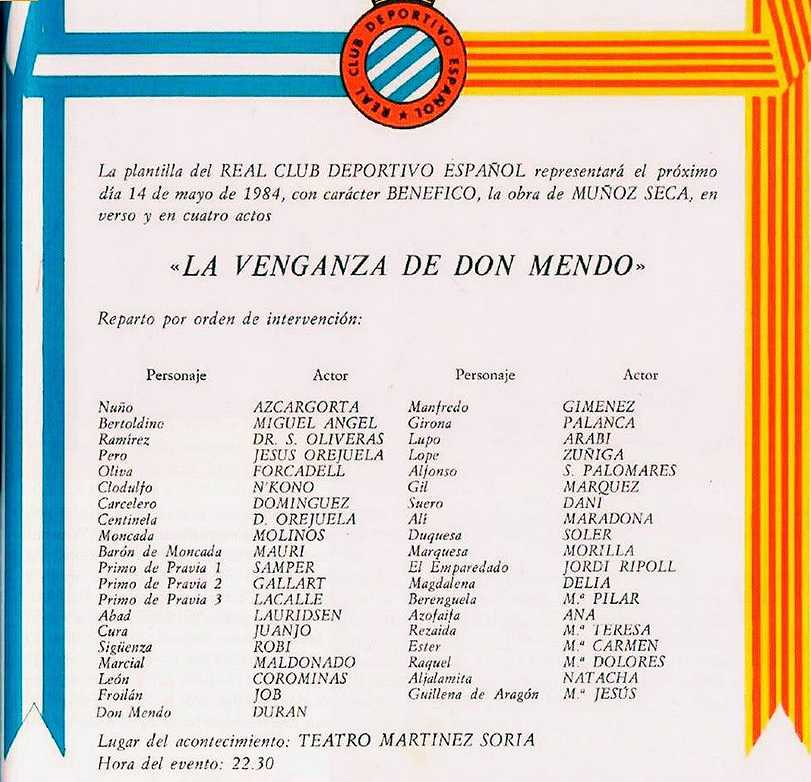
A total of 39 characters make up the cast of Don Mendo, distributed as follows:
- 25 members, the entire first team squad of the 83/84 season: N'Kono, Domínguez, Domínguez, Durán, Job, Arabí, Miguel Ángel, Maldonado, Soler, Gallart, Corominas, Dani, Robe , Lauridsen, Zuñiga, Molinos, Diego Orejuela, Márquez, Lacalle, Samper, Morilla, Giménez, Jesús Orejuela, Forcadell, Mauri and Palanca.
- 8 female roles assigned to pairs of players: Delia, Mª Pilar, Ana, Mª Teresa, Mª Carmen, Mª Dolores, Natacha and Mª Jesús.
- 5 members of the coaching staff: Xabier Azkargorta, Juanjo Díaz, Juan Segura Palomares, Dr. Oliveras and Jordi Ripoll.
- And as guest artist, DIEGO ARMANDO MARADONA, who accepted the invitation of Molinos, after the management of his friend Orlando Giménez and who, with his role of Ali, a slipper salesman, won the sympathy of the audience.
With everything ready, the stage for such a great representation was the MARTÍNEZ SORIA theater of the Paralelo in Barcelona, and the date was May 14, 1984, at 10.30 pm. The tickets, priced at between 2,000 and 3,000 pesetas, raised nearly three million pesetas, all of which was donated to the children of the Hospital de San Juan de Dios. The success of the performance was echoed in all the newspapers and surprised the organization itself. It was so funny that the laughter still echoes in the stalls. A theatrical tour was even considered, with proposals from different theaters in Catalonia, an idea that was finally discarded. The main role of Don Mendo in the hands of Miquel Durán had such a stellar performance that he would be worthy of an honorary Oscar as lead actor, paying tribute to the great actors who have played this character, such as José Luis Ozores, Manolo Gómez Bur, José Sazatornil, Raúl Sender, Ismael Merlo or Tony Leblanc. The success of the project and the solidarity nature of the action were accompanied by a placid end to the season, reflected in a tenth place in the league and a remarkable group management by the new Basque coach.
Last act: behind the scenes
- Training prior to the performance: from the bench, Nuño (Azkargorta) calls the exercise: shots to the far post. The crosses from Froilán (Job) and the Baron of Moncada (Mauri) have to be finished off by Pero (Jesús Orejuela) and Manfredo (Giménez) trying to beat Don Mendo (Durán) and Clodulfo (Kono).
- As in any match, there were last minute casualties. Lauridsen, due to his commitment with the Danish national team, was replaced by Joan Ribas, a classic of the Catalan theater. Miguel Ángel, called up by the Spanish U-21 national team, and Maldonado, recently operated, could not be part of the cast either.
- 9 days before the performance, Maradona played the Cup final between Athletic Club and FC Barcelona. The match would end in a baton fight. We don't know if Diego, in his role of Moorish Ali, wore a bruise as a souvenir, but we do know that that final (re)forced his departure from Can Barça. Since he never played in Barcelona after that game, his last performance in Barcelona was not at the Camp Nou, but at the Martínez Soria stadium and surrounded by perico fans.
- 4 days after the game, a group formed by Azkargorta, Durán, Delia, Dr. Oliveras, Lauridsen and Jesús Orejuela performed live a fragment of the play in the program Superstar, Friday night prime time on Televisión Española, presented that night by Lola Flores, accompanied by Montserrat Caballé, Josep Carreras and Raphael. The sports section presented by the legendary Héctor de Mar was dedicated to Espanyol Solidario.
- After their television appearance, the Perico entourage traveled to Salamanca with Jesús Orejuela as their guide. The concierge of an estate, a theater buff, recognized them and recited a whole verse from Don Mendo. They felt like professional actors.
SEBASTIAN GUILLÉN ARANDA
HISTORICAL RESEARCH GROUP OF THE RCD ESPANYOL FOUNDATION