 Back
Back

Josep Pausàs, the Idol of Güell
Born in Colonia Güell in 1910 and educated both locally and at the Escuela del Trabajo in Barcelona, Josep Pausàs soon embodied the ideal of a young man committed to his community, standing out as a footballer with FC Güell, UE Sants, and ultimately RCD Espanyol, where he became a first-team regular and local icon, before a serious injury cut short his promising career and the Spanish Civil War led him to the Aragón front, where he disappeared in 1937, leaving an indelible mark on the memory of his hometown.

Taking a walk through the streets of the Colònia Güell, in Santa Coloma de Cervelló, is synonymous with tranquility and peace. Calm can be felt in the air, and it seems as if time has stood still. One’s thoughts instinctively leap backward: a journey of more than 125 years.
The year is 1890. Eusebi Güell leaves the Vapor Vell factory in Barcelona, created by his father Joan Güell in 1840 in the Sants district, and establishes the Colònia Güell —located between Santa Coloma de Cervelló and Sant Boi de Llobregat— with its textile and corduroy factory, as well as housing for its workers.
It is a privileged enclave of tranquility, far from the frenetic industrial activity of Sants, in contact with nature and within a setting that combines industrial productivity, modernity, workers’ solidarity and Catalan identity in equal measure.
Eusebi Güell, enamored with the work of Antoni Gaudí, becomes the patron of the architect from Tarragona, the foremost representative of Catalan Modernism. The Colònia is crowned by the crypt that bears his name, built only in its lower nave.
Alfonso XIII, who in 1912 would grant the Club Deportivo Español the title of “Royal,” also bestowed upon Eusebi Güell the title of Count of Güell in 1910.
That same year, in 1910, our protagonist is born: Josep Pausàs Margó (9 July 1910, Santa Coloma de Cervelló), a member of the third generation of inhabitants of the Colònia Güell. His father, Climent Pausàs, known as Rigol, was a loom foreman at the Colònia factory and, as a sportsman, stood out as the goalkeeper of the FC Güell team.
On the pitch of Futbol Club Güell, a modest team of the second and third tiers of the Catalan Championship and federated in 1909, important teams paraded, such as Espanyol under Gibert in 1913, Internacional de Sants, or Zamora’s Barça during the 1920s.
Josep Pausàs, known as Pepet, excelled as a student at the Colònia school and later at the Barcelona School of Labour, and soon also as a sportsman. FC Güell —the club from which Jaume Sospedra would also emerge— hired in 1927 the legendary Agustí Sancho as coach, a former Barça player and Olympic silver medalist in Antwerp, accompanied by the divine Zamora, among others.
Pausàs’s stint with the Colònia team was brief, as in 1927 he joined UE Sants. He stood out as a central midfielder and as a full-back. At just 17 years old he made his debut in the Catalan Championship with Sants in the 1927–28 season. He even debuted with the Catalan national team in the tribute match to Patricio Caicedo, played in 1929 against RCD Espanyol, a club that was already showing interest in the player.
His signing for the blue-and-whites has a very singular anecdote. Taking advantage of a friendly match that the Pericos played during the Colònia’s festival in 1930, Espanyol’s directors signed the contract with Pepet Pausàs in the upstairs room of Cal Pausàs while, in the downstairs hall, a Barça director waited in vain with the same intention. On this occasion, the Blaugrana arrived too late and the player joined Espanyol from the 1930–31 season onward.
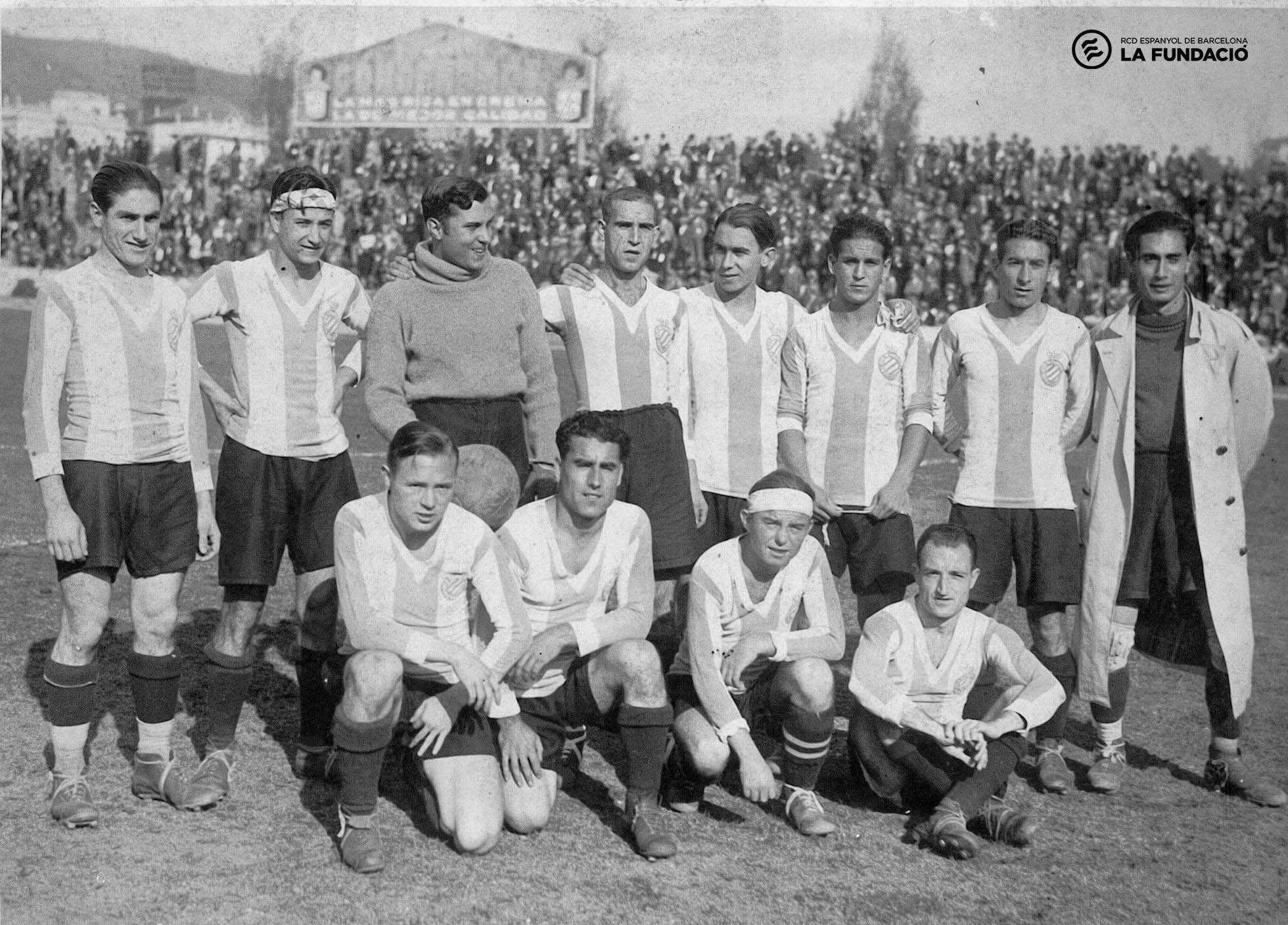
He played as a starting full-back in all 18 League Championship matches with a typical eleven made up of Aznar, Pausàs, Saprissa, Trabal, Moliné, Solé, Besolí, Juvé, Bonal, Prat and Edelmiro. He again wore the shirt of the Catalan national team in the match against a Prague selection played on 6 June 1931.
He soon became the idol of the Colònia: a good lad, a student, active in the activities of the local Ateneu Unió, a member of the xerinola group, a lover of revelry and present at all the dance halls in the region. The followers of Pausàs and Espanyol in the Colònia grew in number, with his neighbor Jeroni Figueras as their foremost exponent. Jeroni, member number 14 of the club, gave Espanyol stickers and visors to the Colònia’s children, recruiting faithful followers for the Perico cause. His militancy had led him years earlier to attend the final of the 1915 Catalan Championship, played in Terrassa (Espanyol 4 – Barça 0), spending all his money on the outbound ticket and having to walk back to the Colònia.
In the 1931–32 season he played 10 League matches, 8 Cup matches and 13 Catalan Championship matches, moving his position forward into midfield and forming a fine trio with Solé and Besolí.
The following season he was a starter in the team that won the Catalan Championship with the following typical eleven: Florenza, Pérez, Trabal, Arater, Pausàs, Solé, Bosch, Garreta, Redó, Prat and Edelmiro. He played only two League matches before falling injured. Sadly, he spent the 1933–34 campaign sidelined. A couple of comeback attempts, with new relapses, forced him to definitively leave football in November 1934.
In total —friendlies aside— he played 30 League matches, 28 in the Catalan Championship and 8 Cup matches. Always as a starter, in full matches and never seeing a single card. On 1 January 1935 a tribute match was played, Espanyol–Catalonia, which ended in a 3–3 draw.
The admiration of the Colònia Güell for Pausàs did not fade. Pepet had a stable job in Barcelona, was a true dandy who dressed elegantly, began a relationship with Benvinguda Solé, Miss Sant Boi, and became involved in social and political issues with Esquerra Republicana de Catalunya (ERC), in a time of marked social and political unrest.
The situation became definitively complicated from July 1936 onward. In the Colònia, in Catalonia and throughout the State, the Civil War broke out. From the Colònia, a channeler of social movements, numerous volunteers went to the front. Tributes to the first fallen in combat soon began, most of them on the Aragon front.
In December 1936, Josep Pausàs married his fiancée, Benvinguda Solé, just a few months before being mobilized when his draft year was called up. He was assigned to the 27th Division, 123rd Mixed Brigade, 491st Battalion of the XI Army Corps, stationed on the Aragon front, one of the most active epicenters of the conflict.
The conquest of Zaragoza and the Battle of Belchite preceded an offensive to take Zuera, a town located 30 kilometers north of the capital and bordering the province of Huesca, where the 123rd Brigade was present with Josep Pausàs in its ranks.
In the last days of August 1937, in the area known as the Vedado de Zuera, where the fighting was especially fierce, Pepet Pausàs was reported missing. Whether he died in combat, a victim of bombings, or was murdered as a prisoner of war remains an unresolved mystery. His parents, immersed in understandable uncertainty, published a notice in La Vanguardia asking for news about the former Espanyol player. Time erased any glimmer of hope.
Finally, on 23 December 1953, a court made Josep’s death official, dated 26 August 1937 in the area of the Vedado de Zuera.
A cruel ending for a great player, whose career was cut short by injury and whose life was taken by the cursed war.
Sebastián Guillén - Grup de Recerca Històrica de la Fundació